

Men's Business Casual Dress Code: A Beginner's Guide to Smart Office Style

Business casual is the most misunderstood phrase in menswear. It has to cover a blazer-and-chinos outfit in a consultancy office and a polo shirt in a design studio, and nobody hands you the rulebook on your first day. The good news is that the code is less vague than it looks. Once you know the handful of pieces that do the work, getting dressed becomes a two-minute decision rather than a daily negotiation.
What Business Casual Actually Means
Business casual sits in the middle of a spectrum. At one end is formal business dress: suit, tie, polished leather shoes. At the other is weekend casual: jeans, t-shirt, trainers. Business casual borrows the structure of the first and the comfort of the second. In practice it usually means a collared shirt or a fine knit, tailored trousers rather than suit trousers or sweatpants, and closed leather shoes.
The simplest test is intention. Nothing about the outfit should suggest you rolled out of bed or came straight from the gym. A tie is optional. A suit jacket is optional. Neatness is not.
Every office draws the line in a different place. A city bank leans formal, a software company leans relaxed. Treat the guidance here as the confident middle ground, then adjust to the room you actually work in.
The Core Pieces Worth Owning
You can build a working wardrobe from a short list. These pieces mix with each other in almost any combination, which is exactly what makes them worth the money.
- Two or three button-down shirts in white, light blue, and one subtle stripe or check
- A fine-gauge knit, crew neck, in navy, charcoal, or oatmeal
- Two or three pairs of tailored trousers: navy, mid-grey, and a lighter tone for warm months
- One unstructured blazer in navy or grey
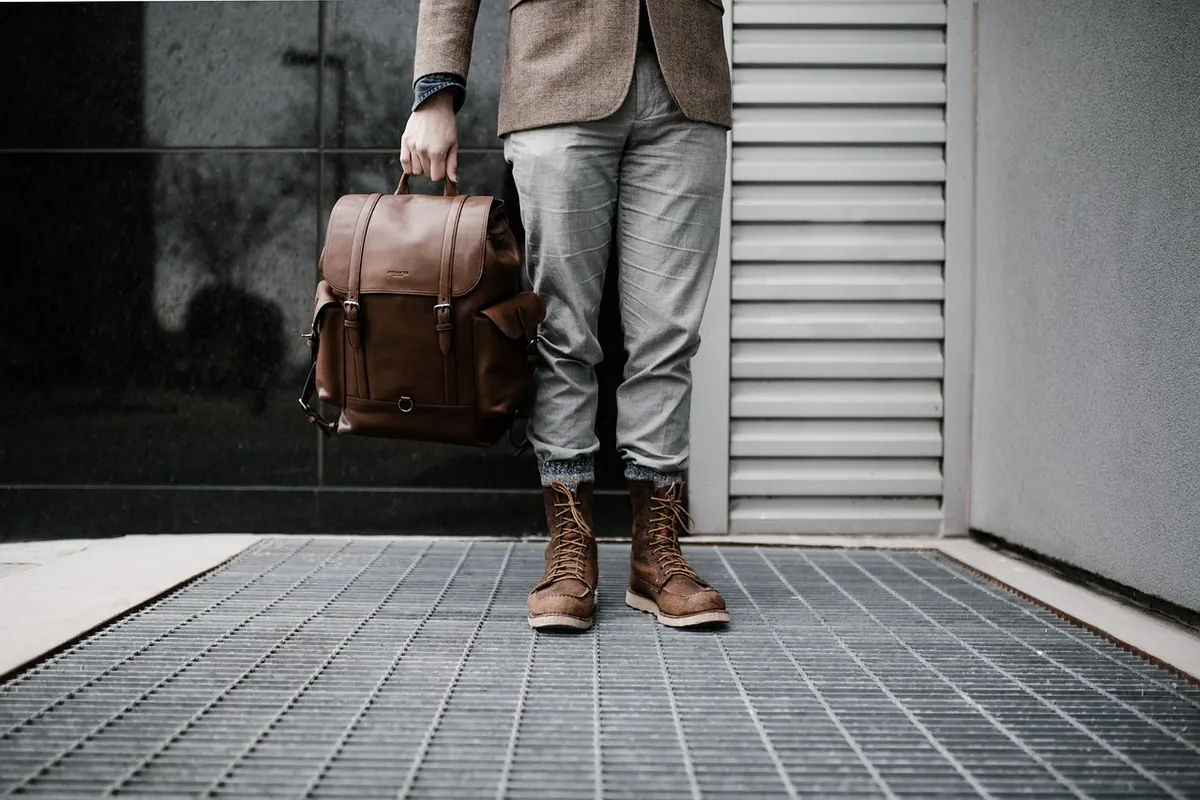
- Leather shoes with a clean profile: derbies, loafers, or Chelsea boots
- A belt that matches your shoes within a shade or two
- Dark, unripped denim, but only if your workplace allows it
Notice what is missing from that list: logos, graphics, and anything engineered to be noticed. Business casual rewards restraint. The fabrics should be cotton, wool, or a linen blend, and they should be clean and pressed.
Three Outfit Formulas That Always Work
The baseline
A shirt, tailored trousers, and leather shoes. Tuck the shirt, wear the belt, and stop there. A light blue oxford cloth shirt with navy chinos and brown derbies is the safest outfit in menswear, and it holds up in nearly every office you will walk into.
The layer
Add a fine knit or an unstructured blazer over the shirt. Charcoal knit, grey trousers, black loafers. Or a white shirt, navy blazer, and stone chinos. If you wear the blazer, leave the tie at home unless the room clearly calls for one.
The warm-weather version
Swap the knit for a polo or a short-sleeve shirt in cotton or linen, choose a lighter trouser, and keep the shoes leather. Sleeves stay short, hems stay clean, and nothing clings. A well-cut linen shirt that creases a little looks far better than a synthetic one that never does.
Fit Matters More Than the Label
An inexpensive shirt that fits beats an expensive one that does not. Check these points before you leave the house:
- The shoulder seam sits at the edge of your shoulder, not past it
- You can fit one finger between your collar and your neck
- The sleeve ends at the wrist bone, so a little cuff shows when you move
- The trouser hem rests on the shoe with a single slight break, or crops cleanly above it
- Nothing pulls across the chest, and nothing balloons at the waist
A local tailor can shorten a hem or take in a waist for a modest cost, and it is often the best return you will get on money spent on clothes. The same goes for a shoeshine and two minutes with an iron. Small efforts show.
Mistakes That Undo a Good Outfit
Most business casual failures are not about taste. They are about one detail that pulls the eye.
- Gym trainers with tailored trousers. Wear leather, or at least a clean minimalist sneaker in a solid colour if your office is relaxed.
- Trousers pooling over the shoe. Have them hemmed. It takes twenty minutes and changes the whole silhouette.
- Socks you can see through. Ankle socks with trousers read as an accident. Match your socks to your trousers.
- Too many accessories. One watch is enough. Skip the bracelet stack, the pocket square, and the lapel pin all at once.
- A wrinkled shirt. No fit or fabric rescues a crumpled collar.
If you are unsure whether something is too casual for the office, it usually is. Save it for Saturday.
Reading Your Own Workplace
Dress codes are absorbed more often than they are written down. Spend your first week watching. Notice what the people one or two levels above you wear, not what the interns wear. That is the standard you are being measured against, whether anyone says so or not.
If you are still unsure, ask. A short question to your manager or to HR — "Is a blazer expected, or are knit shirts fine?" — is normal and rarely awkward. When in doubt, dress one notch above the room for your first month. It is far easier to relax into a dress code than to climb back up after underdressing. If space allows, keep a spare blazer on the back of your chair.
Build It Slowly
Do not rebuild your wardrobe in a weekend. Buy one good pair of trousers and one shirt you actually like, wear them until you trust them, then add the next piece. A wardrobe you understand beats a wardrobe you are guessing at.
For a simple weekday system, decide in this order: trousers first, then shoes, then shirt, then any layer. Trousers and shoes carry most of the formality, so once those two are right, the rest is hard to get wrong. Keep everything clean, keep the fit honest, and the dress code stops being a source of stress.
Photo: Mikhail Nilov / Pexels